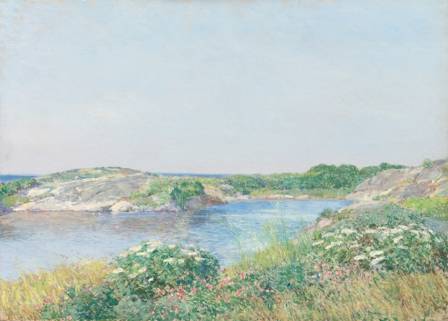
Landscape painting is a genre that long craved formal acknowledgment. It wasn’t until the 17th century that this theme established itself as an independent pictorial genre, standing alongside historical painting, portraiture, and still life. The 19th century witnessed substantial evolution in landscape art, marked by the emergence of the Barbizon School in 1830. From that point onward, plein-air painting grew more accessible, and nature emerged as the most inspiring subject matter. Lush forests, craggy cliffs, and tilled fields became the settings for the creative visions of certain painters. These artworks rank among the greatest masterpieces in the history of art.
1. Nicolas Poussin: Erudite Landscape
The classical artist Nicolas Poussin (1594-1665) crafted deeply learned and profound paintings that hold fundamental importance in art history. He is notably the originator of the “ideal landscape,” where humans are intimately connected to nature, portrayed in a majestic and grand manner. Inviting contemplation, his works offer profound reflections on humanity’s place within the vastness of the divine.
Between 1660 and 1664, he created the Cycle of the Four Seasons. Painted late in his life for the Duke of Richelieu, the series features scenes from the Old Testament, with the landscape taking center stage. He began fulfilling the commission with Spring. In this work, the artist depicts Adam and Eve in the nude, situated in a meadow dotted with trees—including the famous apple tree described in Genesis. Though warm hues and pleasant light emanate from the piece, the painter subtly suggests an impending dramatic outcome. The imminent original sin is particularly highlighted by the presence of God in the top right corner, fleeing the scene to prepare punishment.
Across all the paintings in the Four Seasons series, Nicolas Poussin allows for two interpretations of the scenes. The first, a linear and Christian reading, presents God as the connecting point of all things. Life is understood as a sequence of events foreseen and arranged by Christ, who holds the power to punish or bless based on human behavior. In the cyclical and natural interpretation, inherited from antiquity, actions repeat with each new cycle. However, certain elements are also recomposed and regenerated: the eternal return of specific events becomes inevitable.
2. Giovanni Antonio Canal (aka Canaletto): Urban Vista
The Grand Canal at the Church of La Salute, painted by the Venetian artist Canaletto (1697-1760), represents a distinctive type of landscape painting. It is precisely a Veduta (“view” in Italian), characterized by the accurate depiction of a landscape, often urban. Due to their fidelity to real-world perception, Vedute were created during this period using various instruments, including the camera obscura—the precursor to the modern camera.
While the Italian master’s painting is meticulous in its topographical representation, the landscape portrayed is no less poetic. The almost transparent light shrouds the city in a soft, warm atmosphere, setting the scene in the late afternoon. Beyond being a landscape painting, Canaletto’s work captures the daily life of Venetians. Famous gondoliers are depicted near the Grand Canal, along with merchants and diplomats from the East.
3. Caspar David Friedrich: Spiritual Vista
What time of day would you assign to this scene? Perhaps morning, as indicated by the enveloping white mist. Or evening, suggested by the fading light in the distance? The presence of the Capuchin monk walking along the seashore provides no clear answer. The only certainty: he appears contemplative in the face of the vast surrounding landscape.
Caspar David Friedrich (1774-1840) fits perfectly within the German Romanticism movement that began in 1770. This canvas stands as a remarkable illustration of the painter’s preoccupations throughout his career. Indeed, his scenes—infused with allegory and philosophy—invite the figures in his works to engage in contemplation. Similarly, the viewer themselves is called to reflect on this vast, enigmatic expanse. Almost everything here is reduced to a minimum: line, color, and human presence appear as mere “details” in the composition. Through this work, Friedrich seems to convey a message: humanity is insignificant in the face of nature’s unpredictability and occasional cruelty. Thus, Monk by the Sea invites us to reflect, but above all, to let our minds wander.
4. Eugène Boudin: Marine Landscape
Born in Honfleur, Eugène Boudin (1824-1898) drew most of his inspiration from the skies and seas of Normandy. An admirer of nature and a passionate lover of marine landscapes, Boudin sought to break free from conventional artistic norms. Born in a century dominated by academic art, the painter nonetheless embarked on an alternative path: that of plein-air painting.
Boudin was determined to translate the fleeting impressions of the landscape and the transience of light—undoubtedly making him a precursor to Impressionism. An observant and patient artist, he paid close attention to atmospheric phenomena, striving to capture the vastness of the sky and the Normandy coasts. A modernist, he depicted the new bourgeoisie of his era, painting their elegant dresses and hats with vibrant colors. Self-taught, Boudin applied his rapid, suggestive rather than descriptive technique to his favorite subjects: seashores and ports.
In his landscapes, the painter always gave prominence to the sky and its ever-changing appearances. His “meteorological beauties” took various forms: sketches, pastels, watercolors, oil paintings—all infused with poetic touches that made his work beloved worldwide.
5. Vincent Van Gogh: Turbulent Landscape
Undoubtedly, this work is the most famous among renowned landscape paintings! Its creator, Vincent van Gogh, moved to Arles in 1888. A genuine spiritual journey began for the painter, who sought to combat his inner demons. Though it depicts a gentle starry night conducive to reverie, certain visual elements of this landscape vividly illustrate his psychological state: sharp lines, swirling forms, and contrasting colors.
A study of the artist’s archives revealed that while the various stars are inspired by real nebulae (the Venus nebula was particularly bright in 1889), the village is fictional. The dazzling, drawing light of the moon does little to illuminate the dark night descending on this Provençal village. The intense, thick black branches of the cypress tree add an eerie quality to the overall atmosphere. Countless yellow stars contrast with the various blues of the night, rendering the scene both magnificent and unsettling. The painter’s attention is particularly focused on the central swirling motif. Perhaps this conveys the height of his psychological turmoil? It may also reflect his admiration for Japanese art and prints, which featured numerous spirals and bold colors in the 19th century.
6. Paul Cézanne: Obsessive Vista
While in Provence-Alpes-Côte d’Azur, painter Paul Cézanne gradually chose to withdraw from public life. Sun, cicadas, fruit trees—and above all, Mont Sainte-Victoire—were major sources of inspiration for the artist. This mountain range inspired no fewer than eighty of his paintings. An obsession, one might say?
As a plein-air painter, he appreciated landscapes rich in colors and scents. Unlike the Impressionists, Cézanne did not blend colors together but instead firmly defined outlines, often emphasizing them with black to create distinct volumes. Light is applied in thick impasto, such as the ochre yellow of the stones and the vivid green of the pines, contrasting with the blue of the sky.
He did not faithfully paint reality as he saw it but instead sought to create his own universe, where the slightly geometric shapes of the landscape foreshadowed the Cubist movement. If women were generally regarded as artists’ muses, for Cézanne, it was undoubtedly Mont Sainte-Victoire that fascinated him most. He wrote: “For a long time I was powerless, unable to paint Sainte-Victoire (...). Instead of staying still, it evaporates, becomes fluid. It participates, all bluish, in the surrounding air’s breathing.”
7. André Derain: Vibrant Landscape
Much like Mont Sainte-Victoire, L’Estaque is also a famous source of inspiration for artists—particularly the renowned Fauvist painter André Derain. L’Estaque became a symbolic site for artists of this movement, who drew inspiration from the shimmering, vivid colors of southern France. Here, the painter resided alongside Georges Braque, Henri Matisse, and Raoul Dufy, all also inspired by the unique luminosity of this geographical area.
Rejecting naturalism, André Derain presented a new reality where color took precedence over drawing. His chromatic explorations led him to create works dotted with red, yellow, orange, and sometimes blue hues. Using both warm and cool colors, the composition achieves expert balance. The depiction shows a village scene comprising trees, houses, and various small figures. The painter carefully enhanced the image’s readability by emphasizing the outlines of the composition’s various elements.
8. Douanier Rousseau: Dreamlike Vista
At the very end of the 19th century, Henri Rousseau was one of the leading figures of the Naive movement (1885-1930). Characterized by a deliberate disregard for perspective and realistic proportions, this movement evokes a childlike and highly graphic universe.
In this painting, Douanier Rousseau transports us to the heart of a lush jungle, where various animal species (lions, elephants, birds) hide. Amidst the vegetation, a woman sits in the foreground, listening to the melody played by a flute player. This is Yadwiga, a friend Rousseau had met in Poland. Her pose echoes classic depictions of nudes in art history, such as those seen in Édouard Manet’s Olympia. Her stance is enigmatic and erotic, making her a symbol of desire. During his work in psychoanalysis, Sigmund Freud interpreted this landscape painting as an allegory of the painter’s repressed desires.
The artist’s numerous visits to the Jardin d’Acclimatation and the Natural History Museum in Paris undoubtedly inspired him, as he was known to be an admirer and great connoisseur of vegetation. Countless shades of green—no fewer than 20—contrast with the vivid colors of the giant lotuses surrounding Yadwiga. The harmony of colors transforms this setting into a harmonious and dreamlike landscape, inviting viewers to embark on a journey.
9. Edward Hopper: Solitary Landscape
The works of Edward Hopper (1882-1967) possess a captivating quality, undoubtedly linked to their mystery. This 1927 landscape, in particular, gives rise to conflicting interpretations. Attached to the landscapes of America’s Atlantic coast—more specifically those of New England—Hopper depicts a scene featuring a winding valley, a house, and a lighthouse.
Though the painting is bathed in reassuring light, a sense of unease is unavoidable when confronted with this abandoned, nearly deserted scene. The line between civilization and nature is hard to define. Behind this postcard-perfect setting lies a sort of hidden face, conducive to anxiety and boredom. The artist was known for his fascination with the vertical architecture of lighthouses. Serving as real landmarks in the landscape, lighthouses also symbolize loneliness and storms. The absence of the sea further isolates the scene in a bubble, almost creating a sense of claustrophobia!
It was a habit for Hopper to choose countryside landscapes, even though his best-known works feature thoughtful figures in bars across glamorous America.
10. Nicolas de Staël: Abstract Vista
Painter Nicolas de Staël (1914-1955) approached landscape painting in a significantly different manner from the artists discussed thus far. His geometric compositions, thick impasto, and range of bright colors make his work a distinctly abstract creation. Later in his career, the painter produced works that reconnected more with reality, thereby deeply questioning the opposition between abstraction and figuration. A meticulous artist, he created some of his greatest landscape paintings following careful pencil and ink studies.
Allowing himself great freedom in representing reality, he produced several works highlighting the landscapes of Sicily, which he fell in love with during his trip to Italy in 1953. He never created two identical landscape paintings. Light, like the material or shapes chosen, varied systematically.
Through brightly colored areas, Staël attempted to capture the essence of the landscape he portrayed using pure lines and bold colors. Purple and green strive to find balance with ochre tones and red. The horizon line clearly distinguishes between sky and earth. Such colors may surprise, given that his trip to Sicily took place in the middle of August, when landscapes are arid, dry, and scorched by the sun’s heat. But the arbitrary use of color in this painter directly reflects his desire to convey the sensation he experienced.
Which Will Be Your Favorite Landscape?
This exploration of ten renowned landscape paintings allows us to discover or rediscover places cherished by artists. From the green hills of the south to the Normandy coast’s seashores, landscapes have inspired painters in diverse ways. While the representation of what is seen varies in fidelity to reality, these creators shared one common goal: to convey an impression to the viewer. Serenity, anguish, spirituality—the emotions that nature bestows upon us.